photo courtesy of Barry Rodriguez

Thursday, March 29, 2012

Impossible

"Why, sometimes I've believed as many as six impossible things before breakfast."
Lewis Carroll, Alice in Wonderland


If you had told me two years ago, when I was graduating with my doctorate in occupational therapy, that in just two years I would be advocating for my profession in a foreign country where it doesn't exist - I would have looked you straight in the eye and said, "That's Impossible."


But yesterday, on a dreary Ukrainian morning, the age-old saying "Never Say Never" became a reality.  Invited by Dr. Bashek, the head doctor of Zhitomir's pediatric network and a well-respected medical figure in all of Ukraine, I was asked to speak to a group of leading pediatric neurologists in the region about Occupational Therapy.  There I was - standing in front of more than 60 of the top pediatric neurologists in the Zhitomir region, speaking on behalf of the Occupational Therapy profession and sharing how it can make a difference in the lives of the children with disabilities that they treat.  I also seized the opportunity to advertise for Mission to Ukraine's services and share about their heart for this work.  What an honor and privilege it was to have this opportunity!


In OT school we are taught that every human being - regardless of level of disability - deserves to live a life of individuality and dignity.  We are taught that by promoting and preserving their ability to participate in life's meaningful activities we can also preserve their human connection to the world.  This is what I wanted to nail into the hearts of these doctors.  And, hopefully, my presentation laid the foundation for change yet to come in the lives of Ukraine's children with disabilities.


Sometimes I have to stop and count the steps from where I am to where I started.  Two years ago, when I embarked upon my new career as an Occupational Therapist, I had no idea that I would be led to the country of Ukraine.  I had no idea that I would be working internationally to support organizations like Mission to Ukraine around the world....or that I would be living my dream of forging a future of equality and acceptance for children with disabilities on an international scale.  Yet, each step along the way has brought me to the place that I am now.  And as I look back at the footsteps of my past I become even more determined to keep moving forward, no matter how impossible it may seem.


Tuesday, March 20, 2012

Little Words

"...but a little word from the fingers of another fell into my hand that clutched at emptiness, and my heart leaped to the rapture of living."
Helen Keller


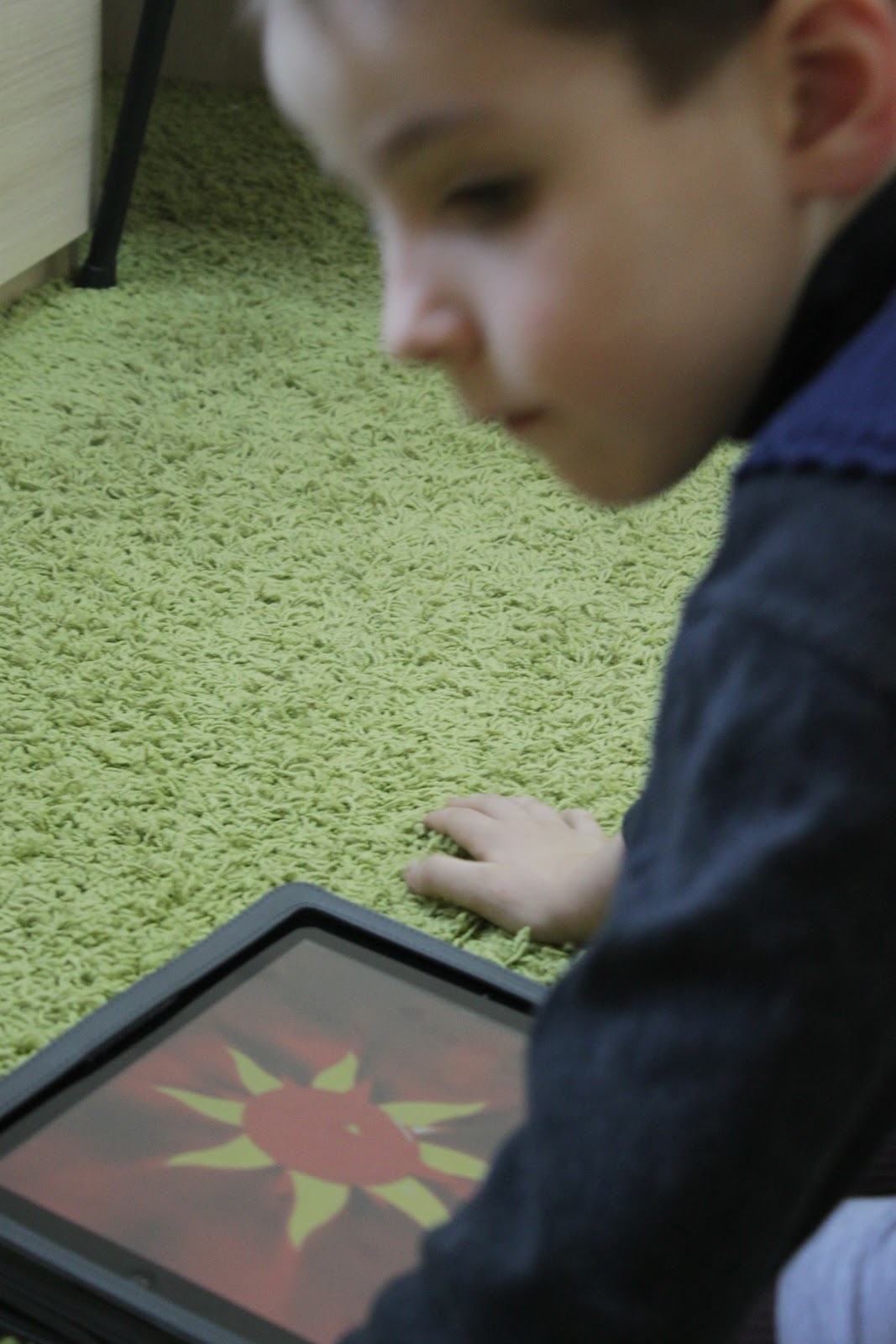
"Mmmmm - MMMMMmmmmmm MMMMmmmmmmm".  The faint sound of tuneless humming was all I could hear as I walked down the hallway to the office of Yuliya, Mission to Ukraine's leader in augmentative communication services.  "MMmmmmm - MMMMmmmmmmmm".  As I pushed open the door I was met by a bright-eyed boy named Misha who was excitedly flapping his hands and humming to his own mysterious and dissonant tune.  "Misha, we are going try something new", Yuliya said as he sat down at the desk.  Misha watched with anticipation as Yuliya brought out a  new device - something he had never seen before.  


Several weeks ago, Mission to Ukraine received a gracious donation to our department: an iPad 2 that could be used for therapeutic gains, namely for use as a communication device for children with communication difficulties.  With the help of a new application called GoTalk, the iPad transforms into a personalized interface with which children with disabilities can use to communicate with others.  Now, at the touch of a button, children - including those with Cerebral Palsy, Autism, developmental conditions, and profound mental disabilities - are able to communicate their thoughts, their desires, their pains, and their joys. 


Misha is one of our special children with Autism - a lifelong developmental disorder that affects the brain, specifically those areas that control social behaviors and communication skills.  While some children have mild forms of Autism, others like Misha live with severe autistic complications, including the complete inability to use spoken language.       But even though these children cannot speak, they are more clever than you think and are fully capable of contributing to their world if given the right tools.  Words have always eluded Misha, leaving him voiceless, with no way to communicate meaningfully with the world around him....until now.


As Misha's therapy session progressed with the use of the iPad 2, Misha's world seemed to open up before him.  He used the iPad to learn the names of different animals.  He used it to indicate to Yuliya that he wanted to blow bubbles, to play ball, and to take a break from work.  He used it to choose which toy he wanted to play with next.  Purpose and meaning were finally at his fingertips.   

I think one of the most universal human desires is to be understood.  We all strive for different ways to communicate with those around us - we all search for ways to connect with another.  And, finally, with the use of this new and exciting technology, we are able to communicate and connect with children just like Misha who have suffered in silence due to a disability that locks their lips and twists their tongues.  For the first time, their voices are being heard - and oh what a beautiful sound it is!


Friday, March 16, 2012

Spring Breeze

"What a life I lead in the winded breeze
What a life I lead in the spring"
Fleet Foxes, Sun Giant


A fundamental lesson I have learned during my time with Mission to Ukraine is that Ukrainians love to celebrate.  Yesterday, MTU put on a beautiful Spring Celebration for our young children with disabilities.  Just as the Spring breeze refreshes and restores the earth after a long cold winter, so did the laughter and the smiles fill the room with the energy and spirit of Spring.


Monday, March 12, 2012

Dangerous

"Everything is dangerous, my dear fellow.
If it wasn't so, life wouldn't be worth living."
Oscar Wilde, The Importance of Being Earnest


In a society that is just beginning to emerge from the broken rubble that the Soviet legacy left behind, people with disabilities and their families living in Ukraine continue to live with the aftermath of this dark regime.  Instead of integrating children into society, many continue to employ a policy of "defectology," a leftover Soviet discipline in which children with disabilities and their families are socially marginalized from civil society.  

The fact is: In Ukraine, the realities of having a child with a disability are heart-breaking.  Husbands leave.  Families are broken.  Survival becomes a daily struggle.  At the urging from their own doctors and family members, many mothers who give birth to a child with a disability are often shamed into abandoning their children to institutions just like Romaniv.  Some new mothers are even encouraged by the doctors to "accidentally" drop their disabled baby on their head so that they would not have the hope of surviving.

But in the city of Zhitomir - in the heart of Ukraine - there is a small army of mothers who refused to succumb to such harsh and brutal acts.  They each made the decision to raise their children at home, no matter what the difficulties and hardship they might endure.


Now, as these children are growing older and becoming adults, Mission to Ukraine has stepped up to do the unthinkable - equip these special people with the skills they need to be successful adults.  Never before have these young adults with special needs been supported in this way.  How do you wash your hands properly?  What are table manners?  How to do you make friends?  What do you do if there is a fire or emergency?  What is sexual abuse and how do you protect yourself from it?  These are all critical topics and skills that every adult must know to become visible, thriving members of the community.  Embarking upon this revolutionary concept, MTU is cutting dangerously deep into the very heart of Ukraine's "defectology" by empowering the vulnerable and giving a voice to oppressed.


Sometimes I look at the faces of these young adults, and I can't help but see myself in them.  I see my own heart in their desire to feel loved, productive, and useful.  And isn't that true for all of humanity?  Don't we all have an inner hunger to be valued?  I am not motivated by guilt or pity, but by our similarities.  And it is in this motivation - this potent force within my own human heart - to be a threat to those who oppress these individuals simply because they are different.  I cannot do anything but be dangerous, with the ultimate goal of forging a future for those who have none.


Tuesday, February 28, 2012

Nothing But Miracles

"And as to me, I know of nothing else but miracles.” 
Walt Whitman, Leaves of Grass


Four months ago, six Romaniv boys were grouped together to participate in what would be the first Functional Skills Training in the history of the orphanage.  Having been trapped in a world of idleness and neglect, we began teaching the boys of Romaniv with the hope of prying open the cages of their mind.  Breaking new ground on something so simple, yet so unfamiliar to the boys, we integrated methods that helped teach them basic developmental and functional skills.  Something as effortless as "washing hands" soon became a weekly crusade.


At first, the boys were overwhelmed, disorganized, and undisciplined.  Their reactions to each activity were primitive and unrefined - showing the clear evidence of years spent sitting in darkness.  Week by week, Natasha of MTU and the nurse of the orphanage worked together to illuminate the locked rooms of their lives.  With repetition and hands-on learning, the boys slowly began to learn.  Though improvement was slow and basic, each lesson was a step.  A step toward independence. A step toward empowerment. A step toward personal dignity.  


After two months of absence from the boys, I finally returned to Romaniv last Friday to check on the lessons and to examine the effectiveness of the program.  I smiled to myself as the boys filed into the room, one by one taking their seats.  I was overjoyed to see them again.  I watched intently as Natasha began the lesson with a prayer and a song.  But as the lesson progressed I found that something was different.  Something was out of place.  Something was present that was not present before.

It was Sergei's words!  The blonde boy who once could only babble with incomprehensible noises was now speaking meaningful Ukrainian words!  "You see?", Natasha said proudly with tears in her eyes, "He speaks!".


Romaniv Orphanage is a funny thing.  One second this place crushes you to pieces - and the next it creates a moment so beautiful you want to cry.  And sometimes you do cry because it's the only way to react to the miracles that you are seeing before your very eyes.


Then the light will break forth like the dawn,
and your healing will quickly appear;
then your righteousness will go before you,
and the glory of the Lord will be your rear guard.

Then you will call, and the Lord will answer;
you will cry for help, and he will say:

Here I Am.


Isaiah 58:8-9


Monday, November 7, 2011

Reflections

In the deep days of autumn, when nearly all of the leaves have fallen and the morning frost whispers about the coming of winter, each new day is a transition into change.  My time in Ukraine has been marked with many transitions, not only for Mission to Ukraine but for my own life as well.  And last Friday, in Romaniv, we embarked upon a different type transition - one that I hope will echo deep into the heart of Romaniv and resonate into the life of each boy.


Since Ukrainian law officially classifies children with disabilities as "unteachable", charitable organizations, such as Mission to Ukraine, are their only hope of learning and growing.  In fact, before MTU started visiting Romaniv, the boys lived no better than animals.  Now, after three years of faithfully teaching the boys basic developmental knowledge and key biblical truths, MTU is stepping into a new role: teaching the boys functional, practical skills for every day living.


Not only is this a new concept for Romaniv, but it will be a new method of teaching for MTU.  While the bible groups with the other large groups of boys will continue, MTU will now lead functional lessons with a  small group of six boys for a trial program.  By downsizing the number of boys in the lesson, more concentrated attention can be focused, thus fostering a more effective learning experience.


Last Friday we held our first session with the small group.  It was amazing to see how well the boys responded to the lesson.  Their eagerness and excitement was simply electrifying.  It was as if they knew they were special - destined for something bigger.  At one point during the lesson we gave each of them a mirror to look at themselves.   One by one, as the boys held up the mirror to look at a reflection that they seldom (if ever) see, I watched as captivation and wonderment set fire in their eyes.  


Since that day, I have been thinking a lot about reflections.  It's simply amazing how a mirror can take light and bend it in such a way to produce an exact replica of something, preserving the quality of the original image.  I think in a lot of ways our hearts serve the same purpose.  Whatever we deeply cherish in life is often reflected by our hearts, caught and perceived by the eyes of those around us.  But the truth is - we are called to reflect something so much more.  We are called to reflect the light of Christ and shine His very likeness into the darkness of the world.

Watching those boys look at their own reflections in the mirror, I am forced to ask myself the question: "What is my heart reflecting?"

Sunday, October 23, 2011

Valik

“What is that you express in your eyes? It seems to me more than all the print I have read in my life.” 

- Walt Whitman


Meet Valik - a 22-year old Romaniv boy with Down syndrome.  He doesn't speak, nor does he join the other boys in activities.  During MTU's lessons, he can typically be found sitting on the benches, lost in his own mysterious world. 


Abandoned at birth by his parents and relatives, he has spent the 22 years of his life under the care of the Ukrainian government.  He was first sent to one of the many children's facilities where they send all unwanted infants and children with disabilities.  After 8 years of living in the children's home, he was sent to the Romaniv Orphanage where he remains to this day.  Four years ago, when he turned 18, he was questioned, evaluated, and ultimately declared to be untrainable, untreatable, and unteachable by the courts of Ukraine.  In addition to forever prohibiting him from being adopted, this status has permanently doomed him to a life in the Ukrainian government system.  Though difficult to imagine, his years at Romaniv will by far be the best of his life.  And, unfortunately, those years are coming to an end.  Soon, Romaniv will be forced by Ukrainian law to release him to a different facility - the very same facility where they send convicted criminals and the clinically insane.  There he will live out the remainder of his years - which, undoubtedly, will not be many.

I often wonder what it would take to change such a broken system. The thought of changing the overall disability structure in Ukraine seems overwhelming and, quite frankly, impossible.  But perhaps it's not always about changing the societal and governmental system.  It's about boys like Valik and the potential impact that I can have in their lives while I still have the chance.  


In times like these, where I am overwhelmed by the unjustified neglect and pain in the boys' haunting eyes, I sometimes catch a reflection of Christ Jesus.  For He, too, knew sorrow and pain in this world, only to die for the sins of the world.  I am reminded that the identity of Romaniv is hidden in Christ's heart - and I am renewed with hope in His redeeming love.


Isaiah 53:2-6


...He had no beauty or majesty to attract us to him,
nothing in his appearance that we should desire him.
He was despised and rejected by men,
a man of sorrows, and familiar with suffering.
Like one from whom men hide their faces,
he was despised, and we esteemed him not.


Surely he took up our infirmities and carried our sorrows,
yet we considered him stricken by God,
smitten by him, and afflicted.
But he was pierced for our transgressions,
he was crushed for our iniquities;
the punishment that brought us peace was upon him,
and by his wounds we are healed.