photo courtesy of Barry Rodriguez

Monday, September 10, 2012

Risk

And the day came when the risk to remain tight in a bud was more painful than the risk it took to blossom.
Anais Nin

As I write this, I am sitting in my room - the very same room that I always have when I come to Ukraine.  The past summer has been a whirlwind of travel, swiftly transforming into a personal crusade: one month in Ukraine, one month in Africa, and now another two months back in Ukraine - all in the hopes of helping organizations better serve children with disabilities.  As I march forward on my crusade - leaving Africa behind and pressing on once again to Ukraine - I find that bits and pieces of my past travels have been seared into my heart, creating scars that remind me why I am here in the first place.

During my trip to Kenya last month, one organization made such a mark in my mind: The Heshima Children's Center in Nairobi, Kenya.  It is no coincidence that the Heshima center was named after the Swahili word for "Dignity" - and it took only moments for me to discover that Heshima is at the forefront of the battle for Kenya's children with special needs.
In Kenya, children with disabilities are a distinctly marginalized population.  Drenched in shame and  often suspected of witchcraft, disabled children and their families are outcasts in every sense of the word.  Families become shaken to their core and the very act of living becomes a difficult struggle.  Not only are these children hidden away in homes - but reports have also shown that Kenya's disabled children are likely to experience debilitating forms of neglect including near-starvation, extreme deprivation, highly unhygienic living conditions, and complete abandonment (1).  In the war of disability rights, it seems that Kenya is losing.

But for places like Heshima Children's Center - the risk is worth the fight for bringing dignity to such children.  Walking onto the grounds of the center, I was immediately amazed at the bustle of activity.  New construction projects covered the grounds and buildings were being constructed in anticipation of reaching and serving more children with disabilities.  With a swift glance around, I noticed that many men were working hard under the afternoon sun.  Yet - to my astonishment - when I stopped to look again, I noticed that two of these workers were teenage boys with mental and physical disabilities.  

"Yes, they are our boys", said our guide.  "They have been with us for many years.  They are older now so we give them jobs to do.  Working make them happy - they can be just like all the other men...using their hands to bring growth to our organization."  I was astonished.  Here were two boys with disabilities - one with Cerebral Palsy, the other with an Intellectual Disability - living in the heart of Kenya...yet, both were able to fully participate in the construction project alongside able-bodied men.  Just when I thought the outcome looked bleak for Kenya, I was inspired by this beautiful picture of what services could and should be for the disabled.  
When it comes to fighting a battle, Risk can be a tricky thing.  Sometimes it motivates us to put everything on the line, because we can't stand to think of living with the alternative.  It can also deceive us into thinking that our choice may not be worth the fight. Yet the funny thing is: there is always a risk.  And we never find out just how far we can go until we push that risk to the brink.  Places such as Heshima Children's Center and their efforts toward creating dignifying opportunities for disabled children continue to remind me that the risk is well worth taking.

(1) Terre de Hommes. 2007. Hidden Shame: Violence against children with disabilities in East Africa. Retrieved September 10, 2012, from http://www2.ohchr.org/english/issues/women/docs/VAWHRC20/OtherEntities/TerreDesHommes.pdf

Wednesday, August 1, 2012

Warm Heart of Africa

If I know a song of Africa,
of the giraffe and the African new moon lying on her back,
of the plows in the fields,
and the sweaty faces of the coffee pickers,
Does Africa know a song of me?
- Karen Blixen


The day has finally come for me to spread open and explore the other hidden corners of the world that shelter children with disabilities.  Filled with resolve and a pinch of uncertainty, I have come to find myself standing in the warm heart of Africa - in a world unlike anything I have ever experienced.  

  
Several months ago, a chance email to an organization called Choose to Invest quickly developed into a  planned trip to Nairobi, Kenya where their Kimbilio Project is being planted.  Born out of a desire to provide Kenya's abandoned disabled children with a place of refuge, nurture and care, the Kimbilio Project aims to build a unique living facility that lifts such children out of the mire.  Additionally, another initiative of Kimbilio is rooted in providing partnering orphanages with the support and training they need to better serve their own abandoned children.


With the collaboration of Choose to Invest, I had the honor of visiting and serving in one of Kimbilio's partnering orphanages called Happy Life Children's Home.  Standing as a beacon in the midst of crumbling abandon, Happy Life openly accepts infants and young children that are discarded from their mothers.  Oftentimes, these children are found in the slums of Nairobi, swaddled in dirty wet blankets and wrapped in plastic bags.  Discovered outside of hospitals, city buses, and ditches - the children of Happy Life are taken in and given new hope.  


Yet, despite the efforts of Happy Life, the need is great and the workers are few.  Crowded rooms crammed wall-to-wall with cribs and crying babies has become the standard for Happy Life.  The older children share their twin-sized beds with one, sometimes two other children.  While the caretakers hustle from crib to crib, changing diapers and feeding bottles, the other babies are left to sit idle in their cribs and wait for their turn to be cradled - if only for just a few short moments.  As a result, opportunities for healthy developmental growth are missed every day.

  
On my second day at Happy Life, I held a brief and simple training session for the leaders and head nurses.  I went over some practical activities they could do with the babies to support their development as well as some simple recommendations of ways they could re-structure their time and resources to create more interaction with the children.  Using one of their toddlers as an example, I showed them simple methods for helping the children learn new skills such as sitting up, rolling over, and holding their head up.  To our amazement, in the middle of the session, our model baby named Abidah instinctively sat up by himself.  "I've never seen him do that before!", said Rosemary, one of the nurses.  "He learned how to sit up just by playing with him - I can't believe it!!!"  Suddenly there was a charge of energy in the room - it was as if lights had been switched on within their very eyes.  

  
I don't know if I will ever step through the gates of Happy Life again - or if I will ever hold little Abidah close and tell him that he is loved.  And I will never know the actual impact of that day. But walking away from that place - nestled in the warm heart of Africa - I walked away knowing that I had left behind something profound.  I had left behind tools of knowledge that will forever change how the nurses and staff care for these precious, abandoned children of Africa.   


Friday, July 20, 2012

Pricetags

"Freedom is never dear at any price.  It is the breath of life.  What would a man not pay for living?"
Mahatma Gandhi


"What do you do when a child comes up to you and starts crying?"  It was a curious question - one that I wasn't prepared to answer in the middle of a training meeting with Angela, the only nurse and teacher willing enough to work with the boys of Romaniv.  She went on, "I have found that, through the day, many of the boys cry without any reason at all - and I never know what to do."  


No answer that I could give to Angela would even begin to scratch the surface of the seemingly insurmountable issues that she is facing.  And, if we scratch too deep for the answer, we will find that the societal reality that children with disabilities around the world live with every day is more shocking and terrible than we think.    

  
In Ukraine, when a child under the age of 4 years is abandoned by their parents - with a disability or without - they are brought to a facility called a "baby house".  Some of the baby houses of Ukraine are well-kept and well-run, providing quality services and a nurturing environment.  But, unfortunately, such facilities are few and far between.  Too often, these facilities are grossly understaffed and overcrowded with room after room lined with cribs.  It is said that walking the halls of such facilities is eerily quiet.  Babies quickly learn not to cry - because, what's the use?  No one will come.  It becomes ingrained in their behavioral DNA that they are unwanted and worth nothing.    


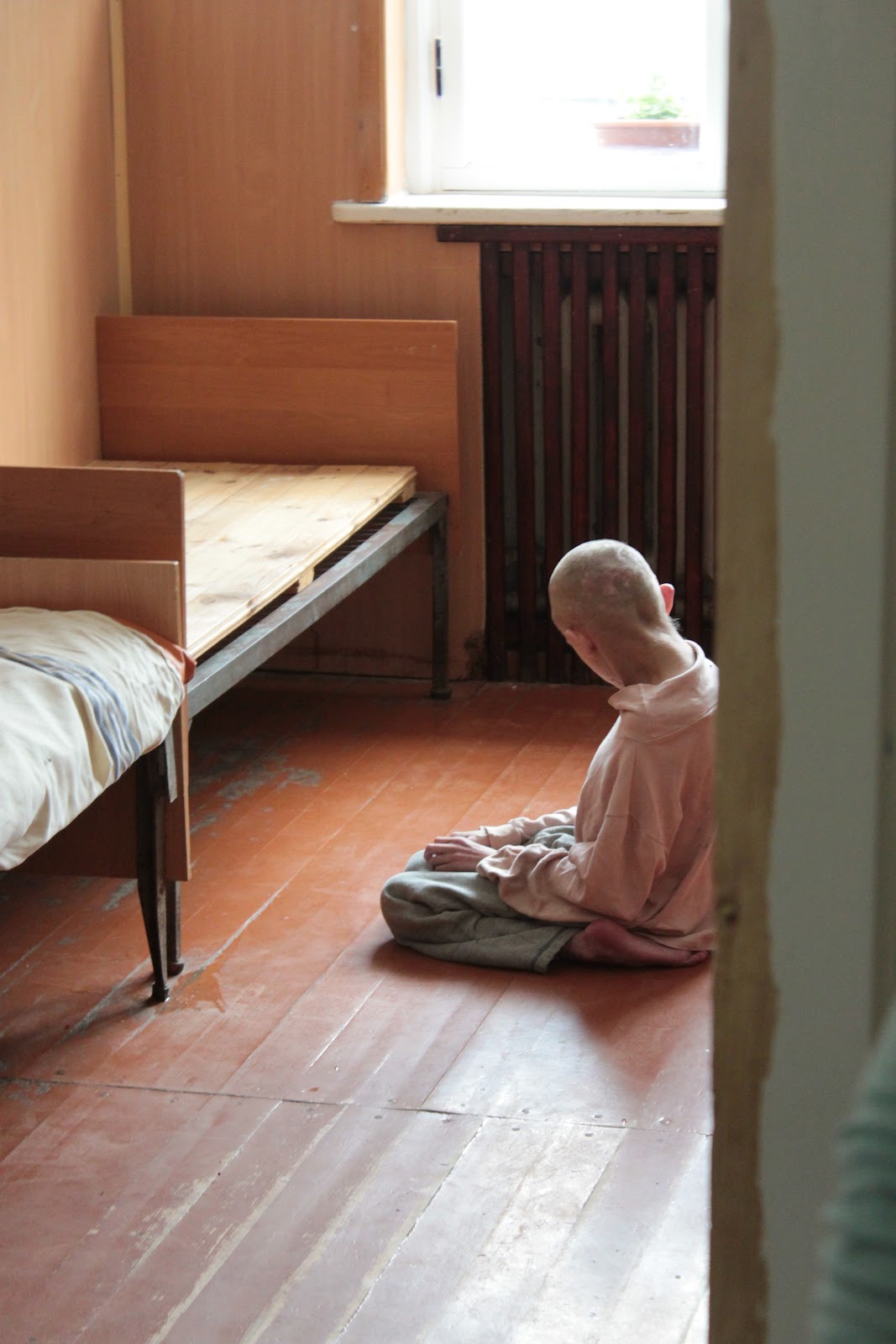
As these babies grow older, this DNA of worthlessness begins to seep deeper into their hearts.  Children with disabilities are sent into a dizzying system of disability institutions at the age of just 4 years.  Evaluated by state officials, children are sent to live in institutions according to the level of disability they are given by the government.  Children with only mild disabilities are sent to facilities with teachers and relatively positive outcomes.  But those children who are deemed "unteachable" are herded into hidden places where the goal is simple: to keep them alive.   


It's hard to imagine such a measly price tag put on a human life....on children who are born with air in their lungs and blood in their veins.  Even the most profoundly disabled human beings have fingerprints and elbows.  Even those that are blind and bed-ridden have eyelashes and earlobes.  Yet the price put on their heads by their own people is meager.    


Sometimes I stop and turn my mind to Romaniv and to the boys who suddenly cry without reason.  And as I reflect on Angela's question, the answer stares straight back at me with such dutiful tenacity that I have nothing left to do but press on.  Press on to create support services that will invest in teaching these people the skills they need to be part of society.  Press on to build communities that recognize that people with disabilities have a value and merit on their price tags.


And as I answer this question for myself, I will ask you the same:


What price tag do you put on people with disabilities?

Sunday, June 24, 2012

Better Things

"There are far, far better things ahead than any we leave behind."
C.S. Lewis


I remember it very clearly - just one year ago when I first came to Mission to Ukraine.  It was in the midst of a dark and bitter-cold winter when I spent 3 weeks trying to soak up all that I could of MTU's disability services. As I led trainings, had conversations, and observed classes - the ideas started flooding in. During my flight home, I began to sculpt a vision of how MTU could build upon what they already had established and grow to become a dynamic and powerful warrior for the rights of Ukraine's children with disabilities.


Now, over a year later, Mission to Ukraine is standing at a crossroads.  After a year of change, revision, and redesign within the programming structure - the time has come for MTU to make strategic decisions about their direction and their future.  The goal is simple: to serve more of Ukraine's children with disabilities with a full and effective battery of services and to integrate them into society.  Over the past year, this goal has been achieved through some of the following programs (just to name a few):


  • The first Transition Program of its kind in Ukraine that prepares adolescents with disabilities for adulthood.
  • A consultative role in a new initiative toward inclusive education for children with disabilities, thus eradicating Ukraine's current practice of segregation in schools.
  • An Occupational Therapy lab, which is a profession that does not yet exist in the country of Ukraine.
  • An Augmentative Communication Program that includes working with cutting-edge technology using an iPad.
  • Implementation of a new functional skills-based strategy in working with orphaned boys with profound disabilities at Romaniv Orphanage - something that is unheard of for such children labeled as "unteachable".
  • A Community Integration Initiative that seeks to expose society to the existence of people with disabilities, which is sending shock waves of changed mentality throughout the region.
  
The change that has already been cultivated in MTU is nothing short of breathtaking. Growth is happening before our very eyes. When looking at this compelling list of programs that have sprung up over the past year through MTU, I can only wonder at the possibilities for what is yet to come.   


I've heard it said that growth is a ceaseless process, one that should always be something we strive for.  Whether in our relationships, our professions, or our personal lives - we should continuously strive for growth.  That is where progress begins.  Strength is not found.  Strength is developed.  It is cultivated in precious moments such as these - when we stop for just a second and ask "Where am I going?".

Sunday, June 17, 2012

My Favorite Day

"What day is it?"

"It's today," squeaked Piglet.

"My favorite day," said Pooh.
A.A. Milne, Winnie the Pooh


I have found lately that it is quite difficult explaining to people why I love my job so much.  Most people that I come across are unable to relate to what I do.  "Isn't it difficult always being on the road?", they ask.  "Don't you get depressed with the things you are seeing?" Of course, every job has its ups and downs, its perks and drawbacks.  Yes, it is difficult being away from home for long periods of time and the travel can be altogether draining.  And yes, a majority of the stories I hear every day are often drenched in sorrow and injustice.
 

But in the midst of the hard days of travel and the weary fight to restore hope for people with disabilities in Ukraine and around the world - some of my favorite days are the ones when I first return to Romaniv.


Sometimes I struggle to explain to others the electrifying jolt that comes over me when I descend the steps of Romaniv.  Or the warmth in my heart when I shake the eager hands of the boys.  But even if my clumsy words fail to describe the rapturing experience that comes over me - I will always carry these favorite days in my heart.  And that's what gets me through the rest.


Monday, May 21, 2012

"I don't think of all the misery, but of the beauty that still remains."
Anne Frank, The Diary of a Young Girl


Sunday, May 13, 2012

The Story of a Mother

"But the distressed mother bent down over all the smallest plants, and heard within them how the human heart beat; and amongst millions she knew her child's."
Hans Christian Andersen, The Story of a Mother


In America, today is a special day for celebrating our mothers.  Flowers are sent.  Cards are delivered.  Smiles and well-wishes leap from the lips of children young and old on this day.  In light of this holiday and what it means, I want to introduce you to my mother - who has breathed inspiration into my heart since the day I was born.

Throughout the years I have heard stories of my mother's early life and the strength that she has cultivated through it.  She has never been one to be spared from the stormy seas of life - yet  she has always sailed straight into the center of each storm with her face to the wind.

At the age of 19, my mom's life changed forever with the sudden death of her father, whom she loved dearly.  Even today, it is clear that this event has shaped how she views and loves her own children and family.  With tenacity and strength, my mother tirelessly fights to maintain her relationships - because she knows how precious they really are.

Years later, after building a life and family, my mother gave birth to a disabled child, Ben, who has Down syndrome.    Though painful at first, Ben's birth quickly became a source of joy and pride in my mother's life.  Over the years I have watched in awe of the strength, sinew, and sacrifice that she put forth in nurturing Ben.  Little did she know those 20 years ago that the disabled baby boy she brought home and loved with every ounce of her heart would one day inspire a group of hurting and broken Ukrainian women that are struggling to raise their own children with disabilities.

 
For my most recent trip to Ukraine, I asked my mother to come to Ukraine for a week to spend time with the mothers of children with disabilities.  And, true to form, she generously agreed to give up her time and energy for the sake of counseling these women.  She led group discussions with the mothers, listened to them, met their children, and even led the first-ever Mission to Ukraine Parent Seminar in the hopes of stirring hope into their hearts.

They were broken women.   Women who had been scorned by society and abandoned by both friends and family.  They were women who were told that they were fools for not killing their disabled child at birth.  These women fought for the lives of their disabled children and knew resilience in its true form.  Watching my mom speak to them, it was as if she had known them all her life.  Although they live thousands of miles apart and spoke a different language - my mother was one of them - because she's a fighter too.


She doesn't know it - and I certainly don't tell her as much as I should - but my mother is my daily inspiration.  She has cared for me, supported me, and taught me how to be a better woman.  I can only hope that one day I will be half the mother that she has been for me.  She has helped to shape and mold me into who I am today, and for that I cannot thank her enough.


Happy Mother's Day, Mom!